One of the most expensive mistakes a first-time author can make happens long before Amazon, ISBNs, cover design or the peculiar midnight misery of discovering that page 147 has somehow become page 149.
It happens when you pay for the wrong professional help at the wrong stage of the book.
One client later told me he hadn’t realised developmental editing was a separate stage. This was an established author. He had originally come to me with a very specific request for line/copyediting, so I took that brief at face value and did exactly what he asked. Only afterwards did he decide he was unhappy with the underlying content and needed a developmental edit as well. The lesson for me was clear: even when an author arrives convinced they know what service they need, I now assess the manuscript first rather than assuming the diagnosis is right. That is one mistake I have no intention of repeating.
Another current Harvard Ink client recently admitted that, before reaching us, she had spent more than two years working with a book coach at around R8,000 a month. I cannot judge everything that happened within that relationship, and coaching itself can be extremely valuable. The problem was the outcome: when the manuscript eventually reached us, it still needed substantial developmental work before it was genuinely ready for line/copyediting.
She told me she wished she had known me at the beginning because, in her words, I am honest and clear about what a book actually needs.
I appreciated that enormously. I was also rather horrified on her behalf.
R8,000 a month for expert developmental guidance, manuscript review, structured feedback and measurable progress may be perfectly reasonable. R8,000 a month becomes considerably harder to justify when, two years later, the author discovers that the structural work she thought had been happening still needs to be bought separately.
And therein lies one of the great mysteries of publishing: authors are expected to buy professional services before following a clear book publishing stages guide that explains what those services are or in which order they belong.
Early Book Publishing Stages: Before You Start Writing
A surprisingly common publishing plan goes something like this:
“I have an idea. I shall write 70,000 words and then find an editor.”
Sometimes that works beautifully.
Sometimes 70,000 words later we discover that the book has three target audiences, four competing central ideas, no clear promise to the reader, and Chapter Nine is essentially Chapter Four wearing a false moustache.
For fiction, the earliest development stage means understanding the premise, genre, audience, protagonists, central conflict, stakes, point of view, broad character arcs and story architecture.
For non-fiction, particularly business, psychology, self-help, memoir-with-a-purpose and thought leadership, I would go even further. Before writing extensively, you should understand who the book is for, what problem it addresses, what the reader should know or be able to do afterwards, what competing books already exist, where your thinking differs and why you are the right person to write it.
This is not marketing bolted onto the end.
It is part of developing the book.
Stage 1: Concept and viability
This is where a good editor, book strategist or coach can save you an extraordinary amount of wasted writing.
At Harvard Ink, I would rather spend an hour challenging an author’s concept now than charge them months later to reorganise 80,000 words built around the wrong one.
For a non-fiction project, we might ask whether the central promise is clear enough. Is the audience “women”, or is it actually “women returning to senior professional roles after a career break”? Is this another general leadership book, or does the author have a particular framework that changes the way leaders understand a specific problem?
For fiction, we might discover that the premise is excellent but the genre positioning is confused, or that the protagonist has a situation but not yet a compelling story problem.
This is also the time to start researching the market—not because you should write whatever is currently selling, but because publishing a book without looking at what already sits beside it is roughly equivalent to opening a restaurant without checking whether anybody nearby eats food.
Stage 2: Build the architecture before decorating the rooms
A professional book outline is considerably more useful than:
Chapter One: Leadership Chapter Two: Communication Chapter Three: Teams Chapter Four: Success
That is not really an outline. It is four nouns waiting hopefully for a book to happen.
A proper non-fiction architecture should establish what each chapter contributes, what question it answers, what research or examples belong there, how it advances the main argument and why the reader needs it before the following chapter. Reedsy’s current guidance likewise recommends defining the core purpose and reader problem before building the chapter structure.
For fiction, the equivalent might involve major plot beats, character arcs, turning points, conflict escalation, climax and resolution. Some novelists work much more organically than others, and that is perfectly legitimate. But even discovery writers eventually need to know whether the thing they have discovered is a novel.
So where does book coaching fit?
Book coaching can be excellent. It can also become a rather expensive weekly conversation if nobody establishes exactly what the coach is responsible for.
A coach may provide accountability, craft guidance, strategic thinking, regular feedback, developmental input or emotional support through the long process of writing. Those are all valuable things. What matters is knowing which ones you are paying for.
If you are considering a monthly coaching arrangement, ask what will physically exist at the end of three months. Will the coach read pages? How many? Will you receive written feedback? Will they help create or revise the architecture? Are they assessing the book developmentally, or are they primarily helping you keep writing? When does one stage end and another begin?
There is nothing inherently wrong with paying R8,000 a month for coaching.
There is something wrong with assuming R8,000 a month includes developmental editing when nobody has actually said that it does.
A pleasant online call is a service. It is not automatically a developmental deliverable.
What should you roughly expect to pay?
Publishing prices vary spectacularly. Experience, word count, genre, complexity, turnaround, location and level of intervention all matter, so any table promising the One True Price of Publishing deserves the same suspicion as a diet promising you will lose nine kilograms by Thursday.
For South African editorial work, however, we have useful current data. SAFREA’s 2026 rates survey puts the most frequently cited developmental-editing rate at R0.25–R0.50 per word, with a weighted average of roughly R0.75–R1.00; copyediting and proofreading most commonly also appeared around R0.25–R0.50 per word. Hourly editorial rates commonly clustered around R300–R500 depending on service.
Internationally, Reedsy’s 2026 data from thousands of professional quotes puts developmental editing at about US$0.026–$0.053 per word, copyediting at US$0.020–$0.032 and proofreading at US$0.014–$0.021. An 80,000-word book can therefore easily run into several thousand US dollars for professional editing.
Here is the broad territory I would use for budgeting:

The coaching and outlining ranges above are working market guides, not formal South African tariffs; unlike editing, there is no useful national benchmark for these services. That makes proper scoping even more important.
Local pricing also varies enormously. Current South African providers advertise formatting from around R2,500, editing from roughly R0.08 to R0.75 per word depending upon provider and depth, and assisted-publishing packages ranging from the low thousands into R70,000-plus territory.
Price alone therefore tells you surprisingly little. Reviews, referrals, and level of professionalism are key in making these sorts of decisions.
Stage 3: Write the manuscript
Eventually, after all this planning, somebody does have to write the thing.
This may be the author alone, the author with a coach, a co-writer, or a ghostwriter. There is no virtue hierarchy here. A CEO who has twenty years of knowledge but cannot realistically spend nine months writing a book is not cheating by working with a professional writer any more than they are cheating by using an accountant rather than preparing the company accounts with crayons.
What matters is that the manuscript grows out of a clear concept and architecture.
During drafting, resist the temptation to perfect every sentence before you know the chapter belongs. There is very little commercial benefit in spending six hours polishing a paragraph that developmental editing later removes.
Stage 4: Developmental editing — where we ask whether the book actually works
This is the stage that causes the greatest confusion, and it is the stage my current client’s manuscript still needed.
Developmental editing is not correcting spelling.
For non-fiction, it examines the argument, structure, reader journey, credibility, missing content, repetition, evidence, examples, pacing, chapter logic, tone and whether the manuscript delivers what the book promises.
For fiction, it looks at plot, character, motivation, stakes, pacing, point of view, continuity, setting, scene effectiveness and emotional arc.
This is where we may discover that Chapter Seven belongs after Chapter Two, that Chapters Nine and Ten need combining, that a brilliant concept introduced on page 190 should have been introduced on page 40, or that an entire section answers a question the target reader never actually asked.
It can be uncomfortable.
It is considerably more comfortable than discovering these things in Amazon reviews.
And developmental work should happen before line editing, copyediting and proofreading. Paying somebody to polish sentences that may later disappear is publishing’s equivalent of waxing the car immediately before sending it to the panel beater.
Personally, I prefer to do this during the outlining phase, which effectively means a lot of time and money can be saved.
Stage 5: Line and copyediting — now we make the writing work beautifully
Once the book itself works, we can concentrate on how it is written.
Line editing deals more deeply with expression: rhythm, clarity, word choice, repetition, awkwardness, tone and voice. Copyediting is concerned with correctness, consistency, grammar, spelling, punctuation, terminology and style, although in real-world publishing the two services frequently overlap.
A good editor should strengthen the author’s voice rather than replace it with their own.
If every author’s manuscript emerges sounding like the editor, something has gone slightly wrong.
Current Reedsy marketplace data put copyediting at around 2–3.2 US cents per word, with a 60,000-word book averaging about US$1,620.
Stage 6: Proofreading — no, this is still not editing
By proofreading, the large decisions should be over.
Nobody should be asking whether the central argument works or whether the protagonist requires a different childhood.
Proofreading catches the remaining typos, punctuation slips, missing words, formatting inconsistencies and small errors that have survived everything else. It is the final editorial safety net.
There should then ideally be another proof after interior formatting because layout can introduce entirely new entertainment: stranded headings, missing italics, strange line breaks and Chapter Twelve suddenly carrying Chapter Eleven’s running header because Word woke up feeling creative.
Then comes the big strategic decision: traditional or indie?
These routes share the early need for a strong book but diverge considerably afterwards.
For fiction, traditional publishing normally begins with a completed and polished manuscript. For many forms of trade non-fiction, authors may approach agents with a book proposal containing the concept, audience, competing titles, author credentials/platform, chapter outline, marketing case and sample chapters rather than necessarily completing the entire manuscript first.
Penguin Random House describes the conventional route as preparing the manuscript or proposal, finding an agent and then working with that agent to submit the project to acquiring editors. It also points out that this may take months or years and that submission is never a guarantee of a deal.
If a legitimate traditional publisher buys your book, the publisher pays for publishing it.
That bears repeating because a remarkably large industry has grown around making authors feel terribly chosen immediately before presenting them with an invoice the size of a top-notch hatchback.
Literary agents similarly earn when the author earns. The Authors Guild identifies 15% as the standard domestic agent commission, with around 20% common where foreign subagents are involved.
If somebody calls themselves a traditional publisher and then asks you for a large publishing fee, you have not discovered a particularly innovative form of traditional publishing.
You have discovered a different business model wearing traditional publishing’s hat.
What traditional publishing gives you — and what it takes
Traditional publishing can provide editorial investment, professional production, established distribution, sales relationships, industry credibility and access to markets that are difficult for an individual author to penetrate.
In return, you relinquish some control, some rights and a significant portion of each sale. You also relinquish control over timing. There may be a long query process before an agent, another submission process before a publisher and then a substantial production period before publication.
And traditional publication does not make marketing disappear.
It merely means you may have a larger team helping.
Indie publishing: congratulations, you are now the publisher
Indie publishing offers far greater control over the book, schedule, rights, pricing and royalties.
It also means that all the jobs traditionally performed by a publishing house now have your name hovering somewhere above them.
Once the manuscript is editorially ready, you need cover design, interior formatting, ebook production, metadata, pricing, ISBN decisions, distribution, upload, proofs and quality control.
Reedsy’s current 2026 guide estimates that professional self-publishing commonly involves editing costs of roughly US$2,160–$5,040, an average cover cost around US$930, and production/distribution costs ranging from virtually nothing for DIY work to around US$2,000 depending on the book.
You do not have to buy everything.
You do need to know which corners can safely be cut.
Stage 7: Cover design — this is marketing wearing clothes
Authors understandably have strong emotional feelings about their covers.
Readers do not know about those feelings.
They see a thumbnail and decide, often within seconds, whether the book appears professional, relevant and like the sort of thing they read.
A cover therefore has to do more than please the author. It needs to signal genre and subject, remain legible at tiny online sizes, compete visually with comparable titles and work technically across the required formats.
Reedsy’s current data put professional cover design at about US$930 on average, with more than half of projects falling between roughly US$630 and US$1,200. South African pricing can be dramatically lower: current local services advertise professionally designed covers from under R2,000 into several thousand rand depending on whether stock material, bespoke artwork, or illustration is required.
A R2,000 cover is not automatically amateur.
A US$2,000 cover is not automatically brilliant.
Look at the portfolio.
Oh, and because I can, one of my freelancers is SUPER with non-AI covers, thorough, gifted, and he is local so also affordable, especially for international clients. Please go check him out here.
Stage 8: Interior formatting — yes, the inside needs designing too
This is generally the point at which new authors say something along the lines of, “What do you mean I have to design the inside as well? Wasn’t writing the bloody thing enough?”
Print books need proper trim size, gutters, margins, typography, chapter openings, running headers, pagination, front matter, back matter and image treatment.
Ebooks require a separate responsive structure because the reader can change font, screen size and spacing. The print PDF and EPUB are different products, even though the words inside them are mostly the same.
For a straightforward book, local formatting can cost only a few thousand rand. Current South African examples range from page-based layout charges to packages beginning around R2,500; much more complex books with photographs, tables, diagrams or specialist design naturally cost more. Reedsy’s current international figures place about half of professional interior-design projects between US$475 and US$1,275.
Good formatting should largely disappear.
The reader should notice the book, not spend Chapter Three wondering why the typeface has changed.
Stage 9: Metadata and distribution — the unglamorous bit that helps people find the book
The book now requires a title and subtitle that work commercially, an effective description, keywords, categories, pricing, ISBN decisions, territorial information and a distribution plan.
Amazon KDP may be part of that.
It does not automatically need to be all of it.
Depending on the project, you might also consider Ingram, Draft2Digital, Apple Books, Kobo, Google Play, direct selling, or your own website. A business author whose book supports speaking and consulting may require a completely different distribution plan from a romance novelist whose readers live inside Kindle Unlimited.
“Worldwide availability” and “worldwide discoverability” are also very different things.
The first can sometimes be achieved with a dropdown box.
The second tends to require work.
Stage 10: Marketing — which should actually have started around Stage 1
Book marketing is not what happens when the finished book arrives and everyone suddenly remembers that strangers do not know it exists.
The Authors Guild explicitly recommends thinking about marketing from the decision to publish onwards and defining the book’s hook and core audience as part of the process.
At concept stage, marketing means making sure there is a recognisable reader and proposition.
During writing, it may mean building an email list, author website, social presence, professional platform, or community.
Several months before launch, you may begin working with advance readers, endorsements, review copies, relevant influencers, podcasts, media, bookshops, event organisers, and professional networks.
At launch, you may add direct outreach, advertising, promotions, events and concentrated social activity.
After launch, you keep going.
The book has not died because Tuesday arrived.
And traditional authors should not assume the publisher will personally deliver 40,000 readers to their front door either. Publishers market books, but author platform and participation increasingly matter across both publishing routes.
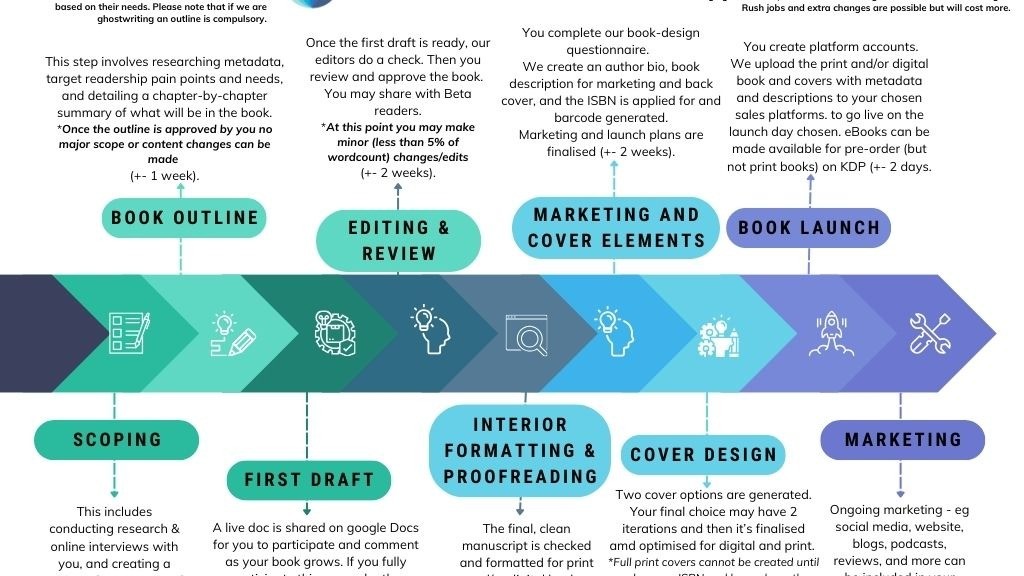
Summary: The Complete Book Publishing Stages Guide
For a serious professionally produced book, the sequence is generally:
Concept and viability → reader/market positioning → outline or architecture → drafting → developmental work → author revisions → line/copyediting → proofreading → cover and interior design → ebook production → metadata and distribution → final proofs → launch → ongoing marketing.
Not every book requires every possible service.
That is important.
An experienced novelist may arrive with excellent structure and need no developmental editor. A first-time business author may save thousands by doing serious concept and outline work before drafting. A memoir may need substantial structural intervention because real life has the irritating habit of refusing to arrange itself into neat three-act structure.
A professional should diagnose first.
The invoice should come afterwards.
Before you hire anyone, ask better questions
Don’t ask only, “How much do you charge?”
Ask what they believe your book needs at this particular stage. Ask what is included, what is excluded, what you will physically receive, how much manuscript they will review, what comes next and whether further professional work will probably be necessary.
Ask whether you retain your rights.
Ask for examples of relevant work.
Ask what happens when either of you believes the manuscript needs something outside the agreed scope.
And perhaps most importantly, ask:
“At the end of working with you, what stage of publication will my book actually be ready for?”
That one question might save you a remarkable amount of money.
Which brings me back to my current client
The difficult part of her experience is not that she hired a book coach.
It is that she believed the work she was paying for was moving the manuscript substantially closer to editorial readiness, while significant developmental problems were still waiting when the coaching relationship ended.
Perhaps expectations were never defined clearly enough. Perhaps the coach saw their role differently. I was not there, and I am not interested in publicly prosecuting somebody else’s professional relationship.
I am interested in what an author can learn from it.
After more than two years and a considerable investment, my client should not have been surprised to discover which stage her book was actually at.
That should have been clear.
Where Harvard Ink fits into this
At Harvard Ink, we can work with an author from the first slightly mad sentence beginning, “I’ve been thinking about writing a book…”, right through to publication.
But that absolutely does not mean we believe every author should buy every service from us.
Sometimes the right next step is a consultation.
Sometimes it is market research and a professional outline.
Sometimes the manuscript genuinely needs developmental editing.
Sometimes it doesn’t, and I would rather tell you that than invent a reason to charge you for it.
Sometimes the best advice is simply: go away and write the next 20,000 words, then come back.
Based in South Africa and working internationally, we help authors develop, write, edit, design and publish books for international English-language markets. Because Harvard Ink stays deliberately small, we get to know the author and the book rather than getting tremendously excited during the sales process and then introducing your manuscript to its new lifelong companion, Project Number 64721.
Professional publishing is expensive enough without paying twice for the same stage.
It should also be possible to ask somebody, “What do I actually need?” and trust that the answer won’t mysteriously include everything they happen to sell.
Good publishing support should leave you clearer about your book, your options, your costs and your next step—not simply poorer and clutching another invoice.
If you are somewhere between I think there’s a book here and Dear God, apparently I have been doing this in the wrong order for eighteen months, we are always happy to have a no-pressure conversation about where your project really is and what should happen next.
Book a free chat with Harvard Ink
Explore Harvard Ink’s publishing services
Thank you for reading Part 5 of our series – The Indie Author’s Publishing Survival Guide. To read our other posts on self-publishing for authors and writers, they’re right here:
Read Part IV of the series here.
Read Part VI of the series here.
Originally published on LinkedIn September 3 2026. https://www.linkedin.com/pulse/indie-authors-publishing-survival-guide-from-book-idea-published-leije/


